
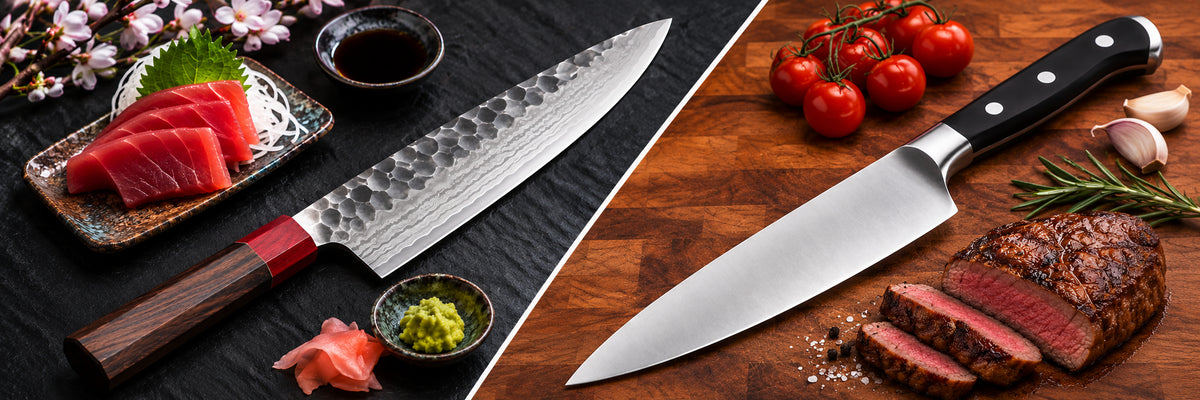
Introduction: Chef’s Knives for Everyday Cooking
Finding the right tool for everyday food preparation transforms ordinary kitchen routines. Whether you are slicing, dicing, chopping, mincing, or preparing meat, fish, fruit, vegetables, and proteins, professional chef's knives serve as the primary workhorse in any kitchen. This commercial investigation compares traditional Japanese and German styles, examines forged versus stamped construction, and evaluates blade fit and hand comfort.
Through practical preparation tasks, we outline clear recommendations across common cooking categories along with essential maintenance practices to keep your blade in top condition.
What Makes a Great Chef’s Knife?
A great chef’s knife should match your cooking style, cutting technique, budget, and physical preferences. Rather than seeking a one-size-fits-all model, evaluate specific design elements to ensure the tool feels natural in your hand during repetitive meal preparation.
Key decision factors include:
- Sharpness: The edge must cleanly separate ingredients without crushing cell walls or tearing soft skins.
- Balance: The distribution of mass between the handle and blade dictates how nimble the knife feels during work.
- Sturdiness: A stable spine and reliable build prevent unwanted flexing during denser prep work.
- Grip Comfort: The handle shape must prevent pressure points and reduce fatigue during extended kitchen prep.
- Blade Size and Steel: Blade length and steel composition dictate maneuverability, weight, and edge retention.
Japanese vs. German Steel
Selecting between Japanese and German styles comes down to blade geometry, edge angle, steel, weight, balance, handle comfort, and durability
Japanese-style knives traditionally feature thinner blades with a more acute edge angle, often between 10 and 15 degrees per side.
The steel used is typically a lot harder, holding a keen edge longer during precise slicing tasks.
Japanese knives need to be looked after very carefully due to the hardness of the steel. If they come into contact with another knife in a drawer, sink, or next to a chopping board, they can chip and need professional sharpening.
These models emphasize lightweight balance and often feature symmetrical or D-shaped wooden handles. They excel at clean push cuts, slicing raw fish, and delicate vegetable preparation.
German-style knives employ slightly softer, tougher steel alloys with a broader blade geometry and an edge angle generally set around 18 to 20 degrees per side.
This sturdier profile adds heft, shifting the balance slightly forward.
German blades usually feature a rounded belly designed for rocking motions, combined with contoured western handles that provide security when chopping through root vegetables, dense squash, or poultry joints. German steel is the go-to for commercial and home kitchens because of its durability
Stamped vs. Forged
Understanding forged versus stamped construction helps clarify purchase trade-offs regarding comfort, balance, price, and care.
- Forged Blades: Formed from a single bar of steel heated and hammered into shape. Forged knives usually include a bolster and a full tang, offering distinct heft, solid balance, and rigid strength. They generally cost more and require careful washing and drying.
- Stamped Blades: Cut or punched from sheets of uniform steel, then heat-treated and ground. Stamped knives lack an integrated bolster, making them lighter and often more affordable. While they offer excellent maneuverability and accessible value, their lighter profile alters hand feel and balance.
Blade Size, Weight, Balance, and Handle Comfort
Chef’s knives can range from 6 to 12 inches in length. A 6-inch model offers agile control in tight quarters, while a 10- or 12-inch profile supports high-volume slicing of large proteins or produce.
The 8-inch format remains the most commonly represented option because it strikes an ideal middle ground for standard prep surfaces. When evaluating a knife, match the tool's weight and balance point to your cutting motion. An evenly balanced knife reduces wrist strain, while handle comfort depends on how securely the grip fits your palm during both pinch and handle grips.
How We Tested
To evaluate real-world performance, practical assessment tasks were conducted across standard preparation scenarios:
- Tomatoes: Slicing ripe skins without applying downward pressure to measure initial edge sharpness.
- Onions: Dicing and fine-mincing to inspect blade tip accuracy and clean horizontal cuts.
- Sweet Potatoes: Splitting dense root vegetables to gauge spine sturdiness, blade wedging, and overall balance.
- Basil: Chiffonading delicate herb leaves to verify whether the edge cuts cleanly without bruising or blackening.
- Chicken: Trimming fat, portioning raw breasts, and parting around cartilage to evaluate slip resistance and maneuverability.
- Hand-Washing: Cleaning and drying each knife immediately following use to examine maintenance ease and handle sealing.
Chef’s Knife Recommendations by Use Case
Different cooking habits call for specific knife attributes. Here is how top categories compare based on construction, performance consistency, maneuverability, comfort, and value.
Best Overall
The best overall recommendation combines sturdy construction with consistent cutting performance across all standard prep tasks. It offers a comfortable, lightweight feel that prevents hand strain during extended meal prep, paired with an 8-inch profile versatile enough for both rocking chops and linear slices.
Best Value
The best value option focuses on balanced maneuverability and dependable sharpness without the premium price tag of luxury metalwork. This option provides reliable cutting efficiency and balanced ergonomics suited for home cooks who prepare meals daily.
The value is in the construction and style. High-carbon steel, down to stamped construction with commercial handles.
Best Budget
The best budget category serves cooks who want an accessible price while still getting a functional chef’s knife for everyday kitchen tasks. Typically built with durable stamped construction, it delivers dependable slicing and dicing capability for routine meals.
Best for Butchering
When preparing meat, fish, and whole proteins, the butchering category provides added blade height, a sturdier spine, and a stable grip. It easily portions raw beef, trims silver skin, breaks down whole chickens, and handles firm cuts around joints without edge deflection.
Best Japanese-Made Chef’s Knife
The best Japanese-made chef’s knife emphasizes refined blade geometry, an acute edge angle, and premium steel composition. It delivers unmatched precision for thin slicing, vegetable julienning, and clean, delicate cuts where maneuverability and balance are paramount. That said, durability isn't a Japanese blade's strong suit in today's kitchens, especially when you're cutting root vegetables and debone meat.
Chef’s Knife Care
Proper knife care and honing preserve your blade's edge and structural integrity over years of service:
- Hand-Wash Only: Clean your knife by hand using warm water, mild dish soap, and a soft sponge. Never place high-grade knives in a dishwasher, as high heat, harsh detergents, and water pressure will damage both the steel edge and the handle material.
- Dry Immediately: Wipe the knife completely dry with a clean towel right after washing. Avoid soaking knives in sinks, which exposes metal to corrosion and presents safety hazards.
- Hone Regularly: Honing realigns the microscopic teeth along the cutting edge without removing metal. This maintenance process differs from sharpening, which physically grinds away steel to form a brand-new edge bevel.
- Safe Storage: Never store blades loose in kitchen drawers, where contact with other metal tools chips the edge. Use a dedicated wooden block, an in-drawer tray, or a magnetic strip.
Conclusion
Selecting the right chef's knife requires matching blade geometry, construction type, and balance to your specific cooking routine. Whether you favor sushi-style slicing of Japanese steel or the rugged heft of a forged German profile, personal comfort and knife balance matter most. Review your daily prep needs, prioritize comfort and versatility, and choose the knife that fits your kitchen workflow.
Frequently asked question
What is the difference between honing and sharpening?
What is the difference between honing and sharpening?
Honing re-aligns the microscopic edge of the blade that bends during normal cutting, keeping it straight without removing metal. Sharpening uses abrasive stones or tools to grind away steel, creating an entirely fresh cutting edge.
Can professional chef's knives go in the dishwasher?
Can professional chef's knives go in the dishwasher?
No. Dishwashers subject knives to high heat, harsh abrasive detergents, and violent water spray that can dull the sharp edge, corrode the blade steel, and crack or warp handle materials.
What is the most versatile blade size for everyday cooking?
What is the most versatile blade size for everyday cooking?
An 8-inch chef's knife is the standard choice for general home cooking, offering an optimal compromise between cutting surface length, weight, balance, and agile board control.
Why choose a forged knife over a stamped knife?
Why choose a forged knife over a stamped knife?
Forged knives are shaped from a solid steel bar, providing greater weight, an integrated bolster, and natural balance. Stamped knives are cut from sheets of metal, resulting in lighter tools that offer agility at a lower cost. So it's more about feel in the hand and cost.


